Nation Above Leader, Humanity Above Nation: The Gita’s Message for a World at War

Saumya Gupta

Nation Above Leader, Humanity Above Nation: The Gita’s Message for a World at War

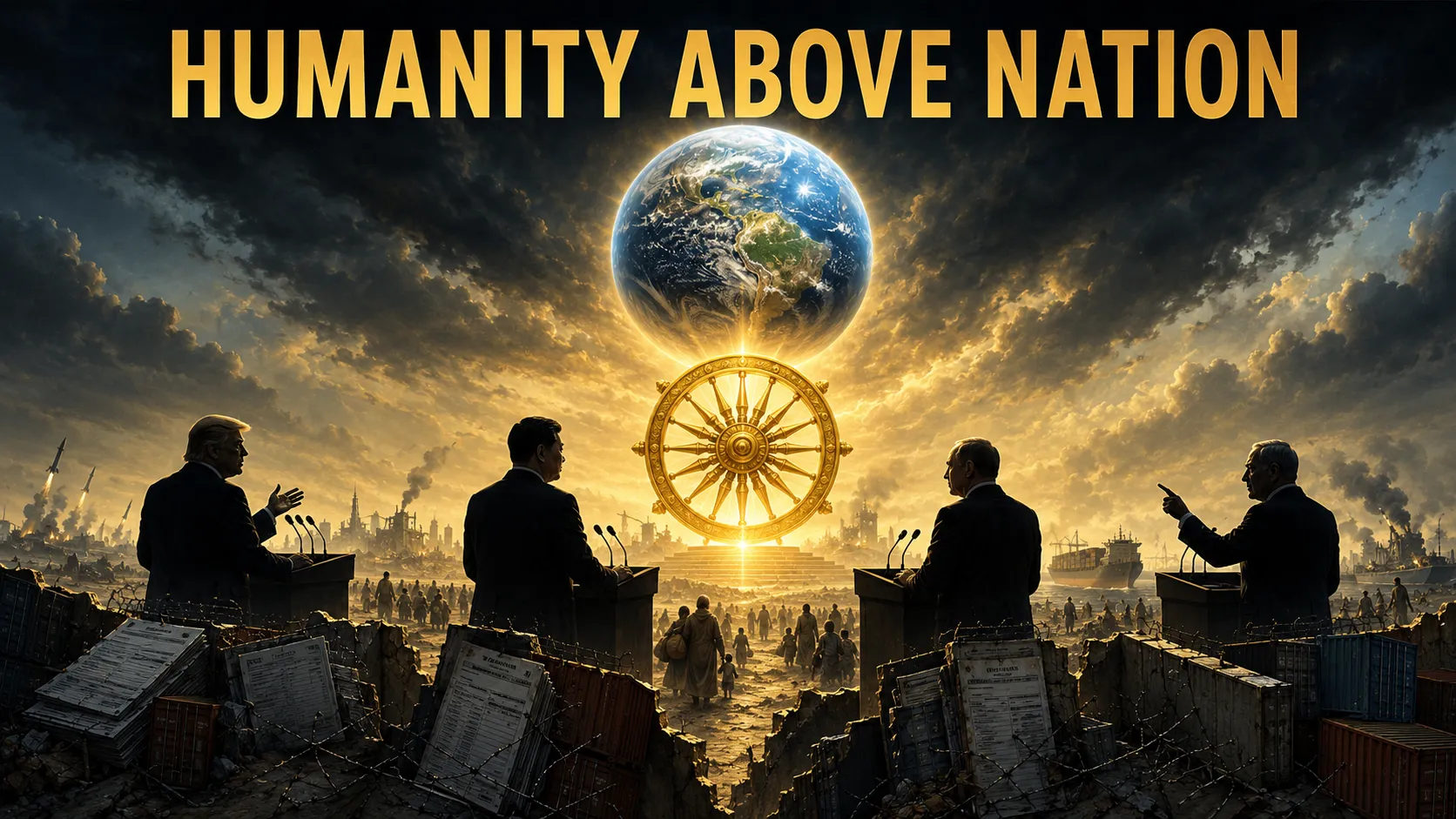
From Donald Trump’s tariff offensive to the wars in Ukraine and West Asia, national interest is increasingly being used to justify actions that hurt millions. An ancient verse from the Bhagavad Gita offers world leaders a timeless lesson in duty, sacrifice and responsible power.

Tariff barriers are rising, wars are spreading and relations between major powers are increasingly shaped by coercion rather than cooperation.

US President Donald Trump says his tariffs will protect American workers and rebuild domestic manufacturing. China defends its economic and strategic assertiveness as essential to its national rise. Russia invokes security to justify its war in Ukraine, while Israel and Iran present military escalation as necessary for their survival.

Every country has the right to protect its people and interests. But what happens when “nation first” begins to mean that the interests of every other nation—and sometimes humanity itself—can be disregarded?

Also Read... Bilaspur Bulldozer Action After 2 Workers Die Near 11 KV High-Tension Line

The Bhagavad Gita offers an answer through a verse written thousands of years before tariffs, nuclear weapons and modern nation-states.

Also Read... Kanker Bear Attack: Female Bear Dies, Another Enters Village, School Shut

The Mantra

Sanskrit

Also Read... Turkey-Saudi Arabia-Pakistan Defence Pact: What the Mecca Agreement Means

एवं प्रवर्तितं चक्रं नानुवर्तयतीह यः।
अघायुरिन्द्रियारामो मोघं पार्थ स जीवति॥ ३.१६॥

Roman transliteration

Evam pravartitam chakram nanuvartayatiha yah,
Aghayur indriyaramo mogham Partha sa jivati.

English meaning

“O Partha, one who does not participate responsibly in this cycle of duty and sacrifice, but lives merely for personal gratification, lives in vain.”

The verse speaks of a universal cycle sustained by contribution. Every person receives something from society, nature and the larger order of life. Therefore, everyone has a duty to give something back.

This is the deeper meaning of yajna: not merely a religious ritual, but action performed for something larger than oneself.

One powerful interpretation extends this principle from the individual to the world: the individual must be prepared to sacrifice for the family, the family for the community and the community for the nation. But the chain does not end with the nation. When humanity’s larger welfare is at stake, the nation must also be willing to exercise restraint.

The Problem With “America First”

Trump’s argument that he must protect American workers is not inherently wrong. Governments are expected to defend domestic industries against unfair subsidies, forced labour, dumping and dangerous dependence on foreign suppliers.

But tariffs do not hurt governments alone. Their cost travels through ports, factories, farms and households.

The United States recently imposed new duties on goods from dozens of trading partners, including India, China and the European Union. Around 55 per cent of Indian exports to the US were brought under an additional 10 per cent levy, although several important sectors received exemptions. Indian lawmakers have warned about the effect on labour-intensive industries and called for greater support for exporters. (Reuters)

For a large government, a tariff is an economic instrument. For a textile worker, leather exporter, jewellery unit or small manufacturer, it can mean cancelled orders and lost employment.

America has the right to negotiate fair trade. But using access to the world’s largest market to compel weaker countries to follow Washington’s political choices risks turning trade into economic warfare.

Trump must place America above his personal popularity. But statesmanship requires another step: on questions affecting global stability, he must be capable of placing humanity above America.

The Same Test for China

China frequently speaks of building a “community with a shared future for mankind”. Yet that promise must be measured against its actions.

China cannot demand unrestricted access to global markets while limiting access to its own. Nor can it speak of a shared future while using economic dependence or military pressure to intimidate smaller countries.

Its conduct towards Taiwan and in the South China Sea will determine whether China becomes a responsible global power or merely another powerful nation seeking an international order built around itself.

Greatness is not demonstrated only through military and economic strength. It is also demonstrated through restraint.

A World Sacrificed to Wars

The broken chakra is even more visible in today’s wars.

Russian President Vladimir Putin must ask whether strategic ambition can justify the destruction inflicted upon Ukraine. An aggressor and a nation defending itself cannot be placed on the same moral plane. Ukraine has the right to defend its sovereignty, but all those involved retain a duty to protect civilians and pursue a just peace.

In West Asia, Hamas’s October 7 terrorist attack and the killing and abduction of civilians cannot be justified as resistance. Israel has the right to protect its people, but that right cannot make Palestinian civilians expendable.

Prime Minister Benjamin Netanyahu’s government must recognise that military power does not remove the obligations of proportionality, international law and humanity. Iran’s rulers must similarly ask whether missiles, armed proxies and threats to regional shipping serve their people—or merely spread suffering beyond their borders.

The same principle applies in Sudan, Myanmar and every conflict in which leaders preserve power while citizens lose their homes, livelihoods and lives.

India Must Follow Its Own Wisdom

India should not quote this civilisational lesson only for Washington, Beijing or Moscow.

India has every right to protect its farmers, industries, borders and strategic autonomy. But Vasudhaiva Kutumbakam—the world is one family—must be more than a slogan used at international summits.

It requires fair trade, climate responsibility, sensitivity towards smaller neighbours and a consistent voice against aggression and civilian suffering.

A country cannot demand fairness from the world’s most powerful nations while ignoring the concerns of those weaker than itself.

Leadership as Yajna

Climate change does not stop at a border. Pandemics do not ask for passports. Nuclear radiation cannot be contained by immigration controls. Tariff wars raise prices across continents, while military conflicts disrupt food, fuel and shipping far beyond the battlefield.

The Gita does not ask leaders to abandon action or national responsibility. It asks them not to make the self the centre of every action.

For those who hold power, that is the true meaning of yajna: leadership must be exercised as a responsibility, not possessed as a personal entitlement.

Trump must think of America before himself, but of humanity before America when the wider world is at risk. Putin, Xi Jinping, Netanyahu, Iran’s rulers, Narendra Modi and every other leader must be judged by the same principle.

The individual must not place personal ambition above the nation. The nation must not place temporary advantage above humanity. And humanity must not destroy the planet in pursuit of unlimited power and consumption.

That is the universal chakra the Gita asks us to protect.
Tags:
english.dainikjagranmpcg.com
09 Aug 2026 By Danik Jagran English

Nation Above Leader, Humanity Above Nation: The Gita’s Message for a World at War

Saumya Gupta

Tariff barriers are rising, wars are spreading and relations between major powers are increasingly shaped by coercion rather than cooperation.

US President Donald Trump says his tariffs will protect American workers and rebuild domestic manufacturing. China defends its economic and strategic assertiveness as essential to its national rise. Russia invokes security to justify its war in Ukraine, while Israel and Iran present military escalation as necessary for their survival.

Every country has the right to protect its people and interests. But what happens when “nation first” begins to mean that the interests of every other nation—and sometimes humanity itself—can be disregarded?

The Bhagavad Gita offers an answer through a verse written thousands of years before tariffs, nuclear weapons and modern nation-states.

The Mantra

Sanskrit

एवं प्रवर्तितं चक्रं नानुवर्तयतीह यः।
अघायुरिन्द्रियारामो मोघं पार्थ स जीवति॥ ३.१६॥

Roman transliteration

Evam pravartitam chakram nanuvartayatiha yah,
Aghayur indriyaramo mogham Partha sa jivati.

English meaning

“O Partha, one who does not participate responsibly in this cycle of duty and sacrifice, but lives merely for personal gratification, lives in vain.”

The verse speaks of a universal cycle sustained by contribution. Every person receives something from society, nature and the larger order of life. Therefore, everyone has a duty to give something back.

This is the deeper meaning of yajna: not merely a religious ritual, but action performed for something larger than oneself.

One powerful interpretation extends this principle from the individual to the world: the individual must be prepared to sacrifice for the family, the family for the community and the community for the nation. But the chain does not end with the nation. When humanity’s larger welfare is at stake, the nation must also be willing to exercise restraint.

The Problem With “America First”

Trump’s argument that he must protect American workers is not inherently wrong. Governments are expected to defend domestic industries against unfair subsidies, forced labour, dumping and dangerous dependence on foreign suppliers.

But tariffs do not hurt governments alone. Their cost travels through ports, factories, farms and households.

The United States recently imposed new duties on goods from dozens of trading partners, including India, China and the European Union. Around 55 per cent of Indian exports to the US were brought under an additional 10 per cent levy, although several important sectors received exemptions. Indian lawmakers have warned about the effect on labour-intensive industries and called for greater support for exporters. (Reuters)

For a large government, a tariff is an economic instrument. For a textile worker, leather exporter, jewellery unit or small manufacturer, it can mean cancelled orders and lost employment.

America has the right to negotiate fair trade. But using access to the world’s largest market to compel weaker countries to follow Washington’s political choices risks turning trade into economic warfare.

Trump must place America above his personal popularity. But statesmanship requires another step: on questions affecting global stability, he must be capable of placing humanity above America.

The Same Test for China

China frequently speaks of building a “community with a shared future for mankind”. Yet that promise must be measured against its actions.

China cannot demand unrestricted access to global markets while limiting access to its own. Nor can it speak of a shared future while using economic dependence or military pressure to intimidate smaller countries.

Its conduct towards Taiwan and in the South China Sea will determine whether China becomes a responsible global power or merely another powerful nation seeking an international order built around itself.

Greatness is not demonstrated only through military and economic strength. It is also demonstrated through restraint.

A World Sacrificed to Wars

The broken chakra is even more visible in today’s wars.

Russian President Vladimir Putin must ask whether strategic ambition can justify the destruction inflicted upon Ukraine. An aggressor and a nation defending itself cannot be placed on the same moral plane. Ukraine has the right to defend its sovereignty, but all those involved retain a duty to protect civilians and pursue a just peace.

In West Asia, Hamas’s October 7 terrorist attack and the killing and abduction of civilians cannot be justified as resistance. Israel has the right to protect its people, but that right cannot make Palestinian civilians expendable.

Prime Minister Benjamin Netanyahu’s government must recognise that military power does not remove the obligations of proportionality, international law and humanity. Iran’s rulers must similarly ask whether missiles, armed proxies and threats to regional shipping serve their people—or merely spread suffering beyond their borders.

The same principle applies in Sudan, Myanmar and every conflict in which leaders preserve power while citizens lose their homes, livelihoods and lives.

India Must Follow Its Own Wisdom

India should not quote this civilisational lesson only for Washington, Beijing or Moscow.

India has every right to protect its farmers, industries, borders and strategic autonomy. But Vasudhaiva Kutumbakam—the world is one family—must be more than a slogan used at international summits.

It requires fair trade, climate responsibility, sensitivity towards smaller neighbours and a consistent voice against aggression and civilian suffering.

A country cannot demand fairness from the world’s most powerful nations while ignoring the concerns of those weaker than itself.

Leadership as Yajna

Climate change does not stop at a border. Pandemics do not ask for passports. Nuclear radiation cannot be contained by immigration controls. Tariff wars raise prices across continents, while military conflicts disrupt food, fuel and shipping far beyond the battlefield.

The Gita does not ask leaders to abandon action or national responsibility. It asks them not to make the self the centre of every action.

For those who hold power, that is the true meaning of yajna: leadership must be exercised as a responsibility, not possessed as a personal entitlement.

Trump must think of America before himself, but of humanity before America when the wider world is at risk. Putin, Xi Jinping, Netanyahu, Iran’s rulers, Narendra Modi and every other leader must be judged by the same principle.

The individual must not place personal ambition above the nation. The nation must not place temporary advantage above humanity. And humanity must not destroy the planet in pursuit of unlimited power and consumption.

That is the universal chakra the Gita asks us to protect.

https://english.dainikjagranmpcg.com/top-stories/nation-above-leader-humanity-above-nation-the-gita%E2%80%99s-message-for/article-25281

--------

🚨 Beat the News Rush – Join Now!

Get breaking alerts, hot exclusives, and game-changing stories instantly on your phone. No delays, no fluff – just the edge you need. ⚡

Tap to join: 

🟢 WhatsApp Channel: Dainik Jagran MP CG

Crave more?

🅕 Facebook: Dainik Jagran MP CG English

🅧 Twitter (X): Dainik Jagran MP CG

🅘 Instagram: Dainik Jagran MP CG

Share the fire – keep your crew ahead! 🗞️🔥

Trending News