


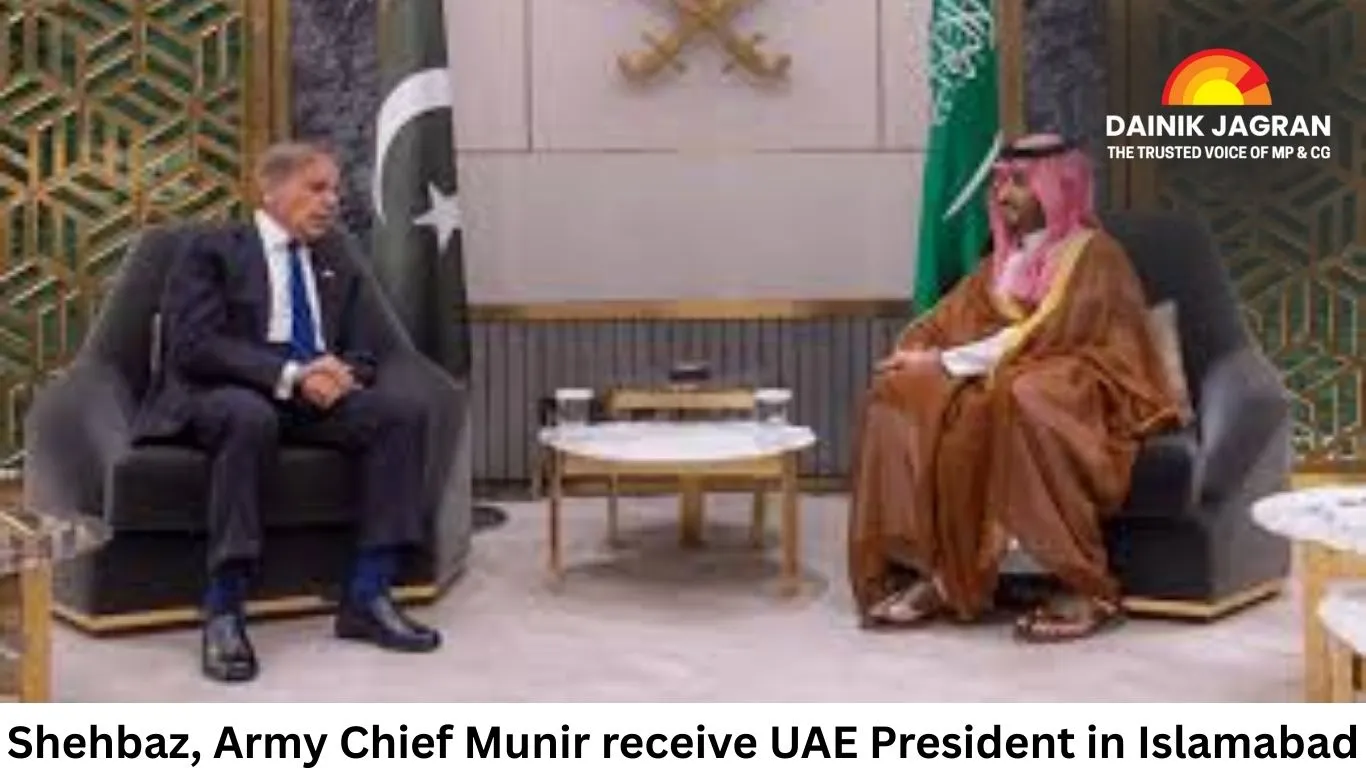
Shehbaz, Army Chief Munir receive UAE President in Islamabad; trade, energy and security ties under focus
Digital Desk
This is Sheikh Mohamed’s second visit to Pakistan in 2025, though his first in an official capacity as President. In January, he had met Prime Minister Shehbaz Sharif during a private visit to Rahim Yar Khan. The current trip comes at a time when Pakistan is seeking foreign investment to stabilise its economy and strengthen its regional partnerships.
According to Pakistan’s Ministry of Foreign Affairs, the UAE President will hold delegation-level talks with Prime Minister Shehbaz Sharif to review the full spectrum of bilateral relations. Discussions are expected to cover trade expansion, energy cooperation, infrastructure development, investment opportunities and evolving regional and global issues.
The Foreign Office said the visit offers an opportunity to further reinforce the “long-standing brotherly ties” between the two countries. Several agreements and memoranda of understanding are expected, particularly in the areas of energy, development, trade facilitation and security cooperation.
To mark the visit, Islamabad’s district administration declared a public holiday in the capital, while large billboards featuring President Asif Ali Zardari, Prime Minister Shehbaz Sharif and Sheikh Mohamed bin Zayed were installed across key locations in the city.
Pakistan and the UAE share close diplomatic, economic and cultural relations, anchored in part by a large Pakistani diaspora in the Gulf state. Between 1.7 and 1.9 million Pakistanis live and work in the UAE, making it the country’s second-largest expatriate community after Indians. Pakistani workers are employed across construction, services, banking, IT and trade, contributing significantly to the UAE economy while sending vital remittances back home.
The UAE remains one of Pakistan’s major trading partners and a consistent source of financial and humanitarian support during times of economic stress and natural disasters. In April this year, the two countries signed three memoranda of understanding covering culture, consular affairs and the establishment of a joint trade council.
Defence and security cooperation is also expected to feature prominently during the talks. Pakistan and the UAE have a long history of military collaboration, including training programmes, joint exercises and coordination among their armed forces. However, officials say there is currently no indication of a formal mutual defence agreement similar to the strategic pact Pakistan signed with Saudi Arabia in September 2025.
That Saudi-Pakistan agreement, which treats an attack on one country as an attack on the other, marked a significant shift in regional security dynamics. Analysts note that while Gulf states are reassessing their security partnerships amid rising regional tensions, the UAE maintains diversified defence relationships with the United States, France and India, making a Saudi-style defence pact with Pakistan unlikely in the near term.
Experts believe Sheikh Mohamed bin Zayed’s visit will also serve as a barometer of investor confidence. If Pakistan is seen as politically stable and economically disciplined, the UAE could significantly scale up investments in sectors such as energy, ports, logistics, minerals and defence manufacturing.
The visit is expected to conclude with renewed commitments on economic cooperation and a roadmap for closer engagement in the coming months.


.jpg)




