


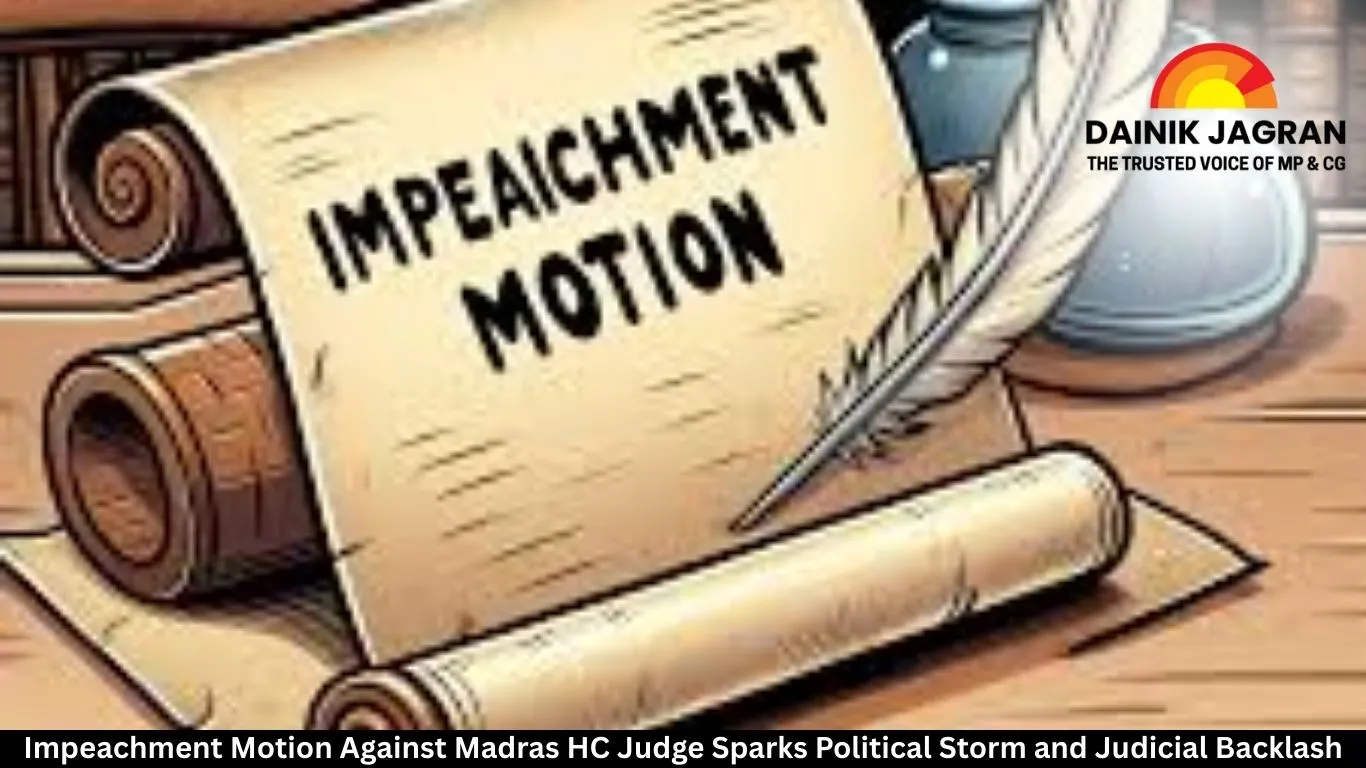
Impeachment Motion Against Madras HC Judge Sparks Political Storm and Judicial Backlash
Digital Desk
A rare and explosive move to impeach a sitting High Court judge has ignited a fierce political and legal debate in India, centering on a dispute over lighting a traditional lamp at a shared religious site in Tamil Nadu.
On December 9, over 100 MPs from the opposition INDIA bloc submitted a notice to Lok Sabha Speaker Om Birla, seeking an impeachment motion against Justice G.R. Swaminathan of the Madras High Court's Madurai Bench.
The motion accuses the judge of "deciding cases on the basis of a particular political ideology," showing favoritism to specific lawyers, and undermining the secular functioning of the judiciary.
The Spark: A Controversial Order on Lamp Lighting
The impeachment push stems from Justice Swaminathan's December 1 order related to the Thirupparankundram hill in Madurai. The site houses both the Subramaniya Swamy Temple and a dargah (Islamic shrine).
Acting on a petition, the judge directed temple authorities to ensure the Karthigai Deepam (a traditional lamp) was lit at a stone pillar (deepathoon) near the hilltop, closer to the dargah.
He stated the pillar belonged to the temple area and allowed a limited group of devotees to conduct the ritual daily with CISF protection, asserting it would not infringe on the rights of the Muslim community.
The Tamil Nadu government, led by the DMK, refused to implement the order, warning it could cause a law-and-order breakdown and communal tension. The state has challenged the ruling before a division bench of the High Court.
Political Firestorm and Judicial Backlash
The impeachment notice has drawn sharp reactions across the political spectrum:
INDIA Bloc's Stance: Led by DMK's Kanimozhi, and supported by leaders like Congress's Priyanka Gandhi and SP's Akhilesh Yadav, the bloc alleges the judge's conduct shows "proved misbehaviour". They claim he has a history of favoring lawyers from a particular community and deciding cases with an ideological bias.
Government Criticism: Union Home Minister Amit Shah condemned the move as "appeasement" politics, stating a judge has never faced impeachment for a judgment in independent India's history.
Wider Political Skepticism: Some within the opposition camp are reportedly skeptical the motion will progress, viewing it partly as political posturing. Andhra Pradesh Deputy CM Pawan Kalyan called it a "weaponisation" of the Constitution and "political intimidation".
The most powerful rebuttal came from 56 former judges of the Supreme Court and various High Courts. In an open letter, they called the move "anti-democratic" and a "brazen attempt to browbeat judges". They warned that using impeachment to challenge judicial decisions "would cut at the very roots of our democracy and the independence of the judiciary".
A Long Road Ahead and Unprecedented Challenge
The impeachment process faces a high constitutional bar. The Speaker must first accept the notice. If accepted, a three-member committee would investigate the charges. Ultimately, removal requires a majority of the total membership and a two-thirds vote of those present in both Houses of Parliament.
No High Court or Supreme Court judge in India has ever been successfully removed through impeachment. This motion, regardless of its outcome, has already sparked a profound debate on the limits of judicial criticism, the independence of the courts, and the intersection of law, politics, and faith.
Your Questions Answered
Q: What exactly did Justice Swaminathan order?
A: He ordered that a traditional Hindu lamp (Karthigai Deepam) be lit at a specific hilltop stone pillar near a dargah in Thirupparankundram, Madurai, ruling the site belongs to the temple area.
Q: Why are 56 former judges upset about the impeachment motion?
A: They believe impeaching a judge over a judicial decision sets a dangerous precedent that intimidates the judiciary and threatens its independence from political pressure.
Q: What happens next with the impeachment motion?
A: Lok Sabha Speaker Om Birla must decide whether to accept the notice for consideration. If he rejects it, the process ends. If he accepts it, a detailed inquiry will follow.



.jpg)




