The Air Pollution Tax: How Toxic Skies Are Shrinking Our Lifespans and Economy
Digital desk
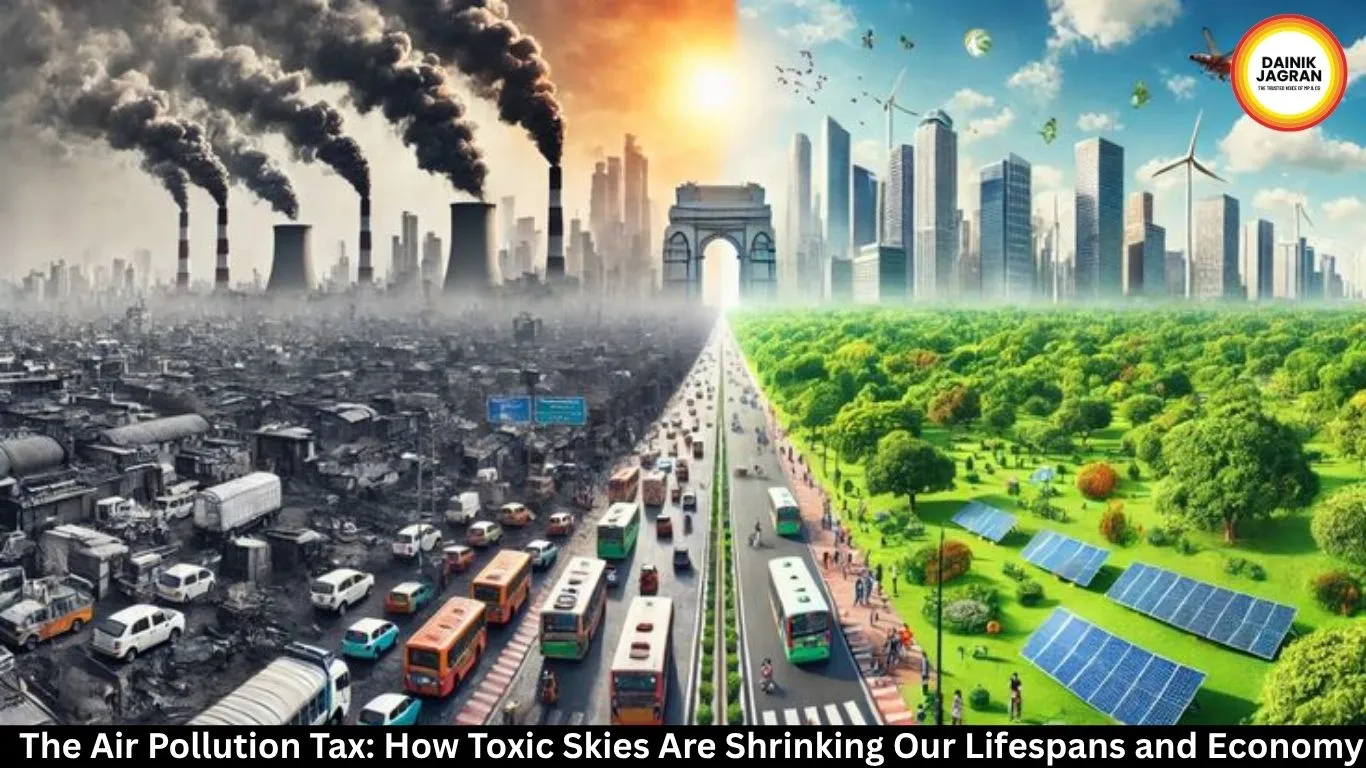
Air pollution has become India's most expensive invisible tax. Unlike income tax or GST, it is never announced in a Budget speech, yet every citizen pays for it—through hospital bills, reduced productivity, missed school days, damaged crops, and, most tragically, shorter lives.
Every winter, the country's major cities disappear beneath a blanket of smog. Air Quality Index (AQI) readings dominate headlines, governments activate emergency measures, and citizens scramble for air purifiers and masks. But once the skies clear, so does the urgency. The cycle repeats with alarming predictability.
The real cost of polluted air extends far beyond respiratory illness. It quietly chips away at the nation's economic potential.
According to global public health research, prolonged exposure to fine particulate matter (PM2.5) increases the risk of heart disease, stroke, lung cancer, chronic respiratory illnesses, diabetes and even cognitive decline. Children growing up in polluted environments face reduced lung development, while older adults remain vulnerable to life-threatening complications.
These health consequences translate directly into economic losses. Sick workers take more leave. Businesses experience lower productivity. Healthcare systems become overburdened. Families spend a growing share of their income on treatment instead of education, savings or investment. The result is a hidden economic burden that affects households, employers and governments alike.
Air pollution also discourages investment and tourism. Cities struggling with hazardous air quality often face questions about livability from multinational companies considering expansion. International visitors increasingly factor environmental conditions into travel decisions. A polluted city is not merely an environmental concern—it becomes an economic disadvantage.
Agriculture suffers as well. Ground-level ozone and airborne pollutants reduce crop yields, affecting food security and farmer incomes. Industrial emissions damage ecosystems and water sources, creating long-term costs that rarely appear in official budgets.
The irony is that many of the largest contributors to air pollution are well understood. Vehicular emissions, coal-fired power generation, industrial pollution, construction dust, waste burning and seasonal crop residue burning collectively create a crisis that demands coordinated action rather than seasonal firefighting.
Technology offers solutions. Cleaner fuels, electric mobility, stricter industrial emission standards, real-time pollution monitoring, better public transport, mechanised road cleaning, scientific waste management and cleaner energy sources can significantly reduce pollution levels. Several Indian cities have already demonstrated that targeted interventions can improve air quality, but these efforts remain uneven and often temporary.
Policy implementation is where the real challenge lies. Regulations frequently exist on paper but suffer from weak enforcement. Monitoring networks have expanded, yet accountability remains inconsistent. Air pollution does not respect municipal boundaries, making cooperation between states and agencies essential.
Citizens, too, have a role to play. Public transport, carpooling, avoiding open waste burning, adopting cleaner household fuels and supporting greener urban planning are important behavioural changes. However, individual action cannot substitute for systemic policy reforms. The responsibility for clean air cannot rest solely on citizens when much of the pollution originates from large-scale infrastructure, industry and energy systems.
Clean air should no longer be viewed as an environmental luxury. It is a public health necessity and an economic investment.
India's aspiration to become a developed nation by 2047 will depend not only on highways, factories and digital infrastructure but also on the health and productivity of its people. A workforce breathing toxic air cannot deliver its full potential.
The true "air pollution tax" is measured not in rupees collected by the government, but in years of life lost, opportunities missed and economic growth sacrificed. Reducing pollution is not merely about cleaner skies—it is about protecting human capital, strengthening the economy and ensuring that development does not come at the cost of the very people it is meant to benefit.
The question is no longer whether India can afford to tackle air pollution. It is whether the country can afford not to.
If you'd like, I can also make this more data-driven with recent statistics and references to studies by organizations such as the WHO, World Bank, IQAir, or Lancet, making it suitable for publication in a national newspaper's opinion section.

The Air Pollution Tax: How Toxic Skies Are Shrinking Our Lifespans and Economy
Digital desk
Every winter, the country's major cities disappear beneath a blanket of smog. Air Quality Index (AQI) readings dominate headlines, governments activate emergency measures, and citizens scramble for air purifiers and masks. But once the skies clear, so does the urgency. The cycle repeats with alarming predictability.
The real cost of polluted air extends far beyond respiratory illness. It quietly chips away at the nation's economic potential.
According to global public health research, prolonged exposure to fine particulate matter (PM2.5) increases the risk of heart disease, stroke, lung cancer, chronic respiratory illnesses, diabetes and even cognitive decline. Children growing up in polluted environments face reduced lung development, while older adults remain vulnerable to life-threatening complications.
These health consequences translate directly into economic losses. Sick workers take more leave. Businesses experience lower productivity. Healthcare systems become overburdened. Families spend a growing share of their income on treatment instead of education, savings or investment. The result is a hidden economic burden that affects households, employers and governments alike.
Air pollution also discourages investment and tourism. Cities struggling with hazardous air quality often face questions about livability from multinational companies considering expansion. International visitors increasingly factor environmental conditions into travel decisions. A polluted city is not merely an environmental concern—it becomes an economic disadvantage.
Agriculture suffers as well. Ground-level ozone and airborne pollutants reduce crop yields, affecting food security and farmer incomes. Industrial emissions damage ecosystems and water sources, creating long-term costs that rarely appear in official budgets.
The irony is that many of the largest contributors to air pollution are well understood. Vehicular emissions, coal-fired power generation, industrial pollution, construction dust, waste burning and seasonal crop residue burning collectively create a crisis that demands coordinated action rather than seasonal firefighting.
Technology offers solutions. Cleaner fuels, electric mobility, stricter industrial emission standards, real-time pollution monitoring, better public transport, mechanised road cleaning, scientific waste management and cleaner energy sources can significantly reduce pollution levels. Several Indian cities have already demonstrated that targeted interventions can improve air quality, but these efforts remain uneven and often temporary.
Policy implementation is where the real challenge lies. Regulations frequently exist on paper but suffer from weak enforcement. Monitoring networks have expanded, yet accountability remains inconsistent. Air pollution does not respect municipal boundaries, making cooperation between states and agencies essential.
Citizens, too, have a role to play. Public transport, carpooling, avoiding open waste burning, adopting cleaner household fuels and supporting greener urban planning are important behavioural changes. However, individual action cannot substitute for systemic policy reforms. The responsibility for clean air cannot rest solely on citizens when much of the pollution originates from large-scale infrastructure, industry and energy systems.
Clean air should no longer be viewed as an environmental luxury. It is a public health necessity and an economic investment.
India's aspiration to become a developed nation by 2047 will depend not only on highways, factories and digital infrastructure but also on the health and productivity of its people. A workforce breathing toxic air cannot deliver its full potential.
The true "air pollution tax" is measured not in rupees collected by the government, but in years of life lost, opportunities missed and economic growth sacrificed. Reducing pollution is not merely about cleaner skies—it is about protecting human capital, strengthening the economy and ensuring that development does not come at the cost of the very people it is meant to benefit.
The question is no longer whether India can afford to tackle air pollution. It is whether the country can afford not to.
If you'd like, I can also make this more data-driven with recent statistics and references to studies by organizations such as the WHO, World Bank, IQAir, or Lancet, making it suitable for publication in a national newspaper's opinion section.

Recommended For You
--------
🚨 Beat the News Rush – Join Now!
Get breaking alerts, hot exclusives, and game-changing stories instantly on your phone. No delays, no fluff – just the edge you need. ⚡
Tap to join:
🟢 WhatsApp Channel: Dainik Jagran MP CG
Crave more?
🅕 Facebook: Dainik Jagran MP CG English
🅧 Twitter (X): Dainik Jagran MP CG
🅘 Instagram: Dainik Jagran MP CG
Share the fire – keep your crew ahead! 🗞️🔥