


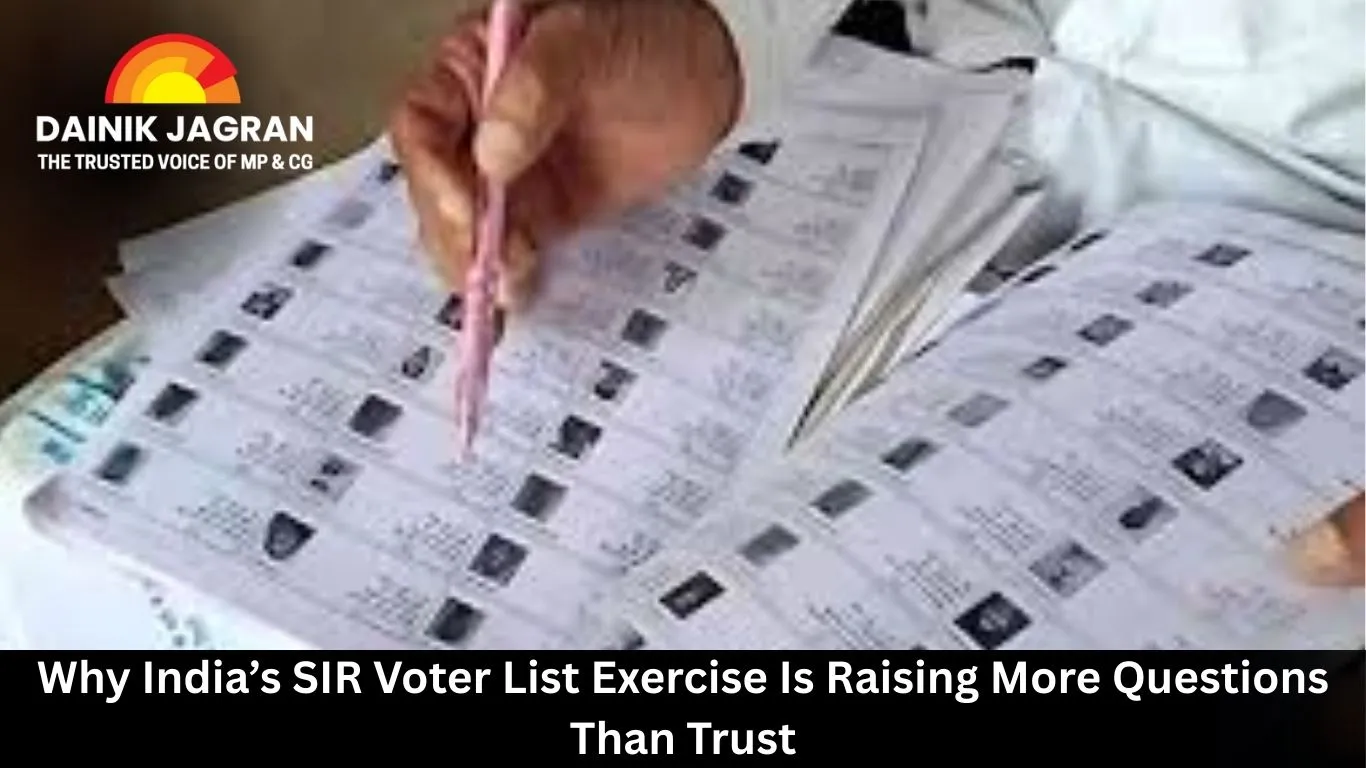
Why India’s SIR Voter List Exercise Is Raising More Questions Than Trust
Digital Desk
India’s ongoing Special Intensive Revision (SIR) of electoral rolls was announced as a major democracy‑strengthening exercise, but it is now trapped in a storm of questions and distrust.
The Election Commission has repeatedly extended deadlines in multiple states, including Uttar Pradesh, Gujarat, Tamil Nadu, Madhya Pradesh, Chhattisgarh and Andaman & Nicobar Islands, officially citing requests from state poll bodies and the need to ensure no eligible voter is left out.
What should have been a showcase of planning and transparency is increasingly looking like a case study in poor preparation and overreach.
In Uttar Pradesh alone, the Chief Electoral Officer has admitted that while over 99 per cent of enumeration forms have been digitised, nearly 2.9 crore entries are still unverified or “uncollectible”.
These include people who have shifted, died, appear as duplicates, or whose forms were never returned, forming almost one‑fifth of the voter list.
When such a huge block of voters is suddenly placed under doubt, the line between technical clean‑up and quiet mass exclusion becomes dangerously thin.
The Supreme Court has stepped in, asking hard questions about where the Election Commission’s mandate ends and where citizenship adjudication begins. Petitioners argue that SIR has turned into an “inquisitorial” exercise that demands extra documents and effectively shifts the burden of proving citizenship onto ordinary voters.
The Court has already underlined that Aadhaar is not conclusive proof of citizenship and has probed whether the Commission can, even indirectly, run a citizenship test through voter roll verification.
Critics fear this model hits the same people who are always the easiest to erase on paper: migrants, women, the homeless, informal workers and those with fragile documentation.
Scholars and civil society groups have compared SIR to past welfare exercises where beneficiaries were told to constantly prove they are “genuine”, while overburdened local officials passed the pressure down the chain.
Overworked Booth Level Officers now carry the responsibility for decisions that can make or break a citizen’s right to vote, often with limited training and almost impossible timelines.
Politically, the controversy has triggered familiar narratives about “infiltrators” and “illegal voters”, especially in states where migration is already a polarising theme.
If millions of names are questioned, the obvious counter‑question follows: were these all non‑citizens, and if not, who will answer for legitimate voters being pushed out in the name of purification? In a country that proudly calls itself the “mother of democracy”, casual experimentation with the franchise of the weakest citizens is more than just a bureaucratic misstep.
SIR, in principle, is not the problem; clean and accurate rolls are essential for free and fair elections. The real danger lies in a process that appears rushed, opaque and insensitive to ground realities, even as it expands its own powers under the cover of technical scrutiny.
If the Election Commission wants to restore trust, it must do more than extend deadlines: it must publicly explain deletions, protect due process, and prove that this revision is about inclusion, not quiet disenfranchisement.


.jpg)




