The Politics of Performance: 12 Years That Changed the Grammar of Governance
New Delhi
Twelve years after Narendra Modi first took office, the most consequential change in India may not be any single scheme, reform, infrastructure project or diplomatic achievement. It may be the transformation of how governance itself is understood, delivered and judged.
The story of the Modi-led NDA Government's twelve years is, in many ways, the story of India's transition from policy paralysis to decisive governance, from administrative leakages to direct delivery, from entitlement to empowerment, and from incrementalism to execution at scale. More importantly, it is the story of a political shift where performance, accountability and delivery increasingly became central to electoral legitimacy. The Modi years altered not only the functioning of government but also the expectations citizens place upon it.
Viewed broadly, this journey unfolded in three phases: system cleansing between 2014 and 2019, resilient crisis management between 2019 and 2022, and accelerated nation-building thereafter. Yet the thread connecting all three phases has been a consistent emphasis on measurable outcomes, responsive governance and a willingness to pursue decisions that previous governments often deferred.
From Policy Paralysis to Performance Politics
When the Modi-led NDA assumed office in 2014, one of its most immediate challenges was reviving an economy weighed down by stalled investments and administrative inertia. The unlocking of more than ₹10 lakh crore worth of stalled projects became an early signal that execution, rather than announcement, would define the government's approach.
Equally significant was the effort to repair the architecture of welfare delivery itself. The opening of more than 56 crore Jan Dhan accounts brought millions of previously excluded citizens into the formal financial system. Combined with Aadhaar-linked Direct Benefit Transfers, this created an unprecedented delivery mechanism through which benefits could reach citizens directly, reducing intermediaries and saving more than ₹2.5 lakh crore in leakages. Governance increasingly moved from promise-making to delivery-tracking.
The introduction of the Goods and Services Tax represented another structural shift. By creating a unified national market, simplifying the movement of goods and encouraging formalisation, GST altered the economic geography of the country. Monthly collections now exceeding ₹1.7 lakh crore reflect not only stronger revenues but also the growing formalisation of the economy.
This emphasis on fixing systems before expanding them became a defining feature of the Modi years. Whether through efforts to improve transparency, strengthen accountability, curb leakages or undertake difficult measures such as demonetisation, the larger objective remained consistent: to build a governance framework capable of delivering at scale. The last twelve years, therefore, are not merely years of schemes being launched; they are years of systems being repaired.
That philosophy extended directly into welfare. Swachh Bharat Abhiyan led to the construction of more than 11 crore toilets, improving sanitation, public health and dignity, particularly for women. PM Awas Yojana, household electrification and the Jal Jeevan Mission similarly sought to convert welfare from periodic assistance into long-term improvements in quality of life, asset ownership and basic living standards.
One of the most consistent themes running through the Modi years has been the emphasis on women's empowerment. Whether through sanitation access under Swachh Bharat, improved access to water and electricity, the abolition of Triple Talaq, or the passage of the Nari Shakti Vandan Adhiniyam providing 33 per cent reservation for women in the Lok Sabha and State Assemblies, the objective extended beyond welfare delivery. It reflected an effort to place women's dignity, security, participation and representation at the centre of public policy.
The resilience of this delivery architecture became most visible during the COVID-19 pandemic. At a moment of unprecedented disruption, the government leveraged its welfare and digital infrastructure to provide free ration to more than 80 crore citizens while using DBT systems to support vulnerable families. What had been built during years of system reform became a critical instrument of crisis management.
Building Capacity for a New India
If the first phase focused on repairing systems, the second sought to build capabilities for a rapidly changing economy.
The ₹20 lakh crore Atmanirbhar Bharat package transformed a moment of crisis into an opportunity for structural reform. Alongside Production Linked Incentive schemes, it supported businesses, protected jobs and strengthened India's manufacturing ecosystem across sectors ranging from electronics and pharmaceuticals to advanced technologies.
Few examples illustrate this transformation more clearly than mobile manufacturing. Once heavily dependent on imports, India today has mobile exports exceeding ₹1.9 lakh crore, reflecting a broader shift from import dependence towards production strength and global competitiveness.
At the same time, Digital India and UPI fundamentally transformed how Indians interact with the economy. What began as a digital payments platform evolved into one of the world's most significant public digital infrastructures, enabling street vendors, small traders, farmers and ordinary citizens to participate in the formal economy. Technology became not merely a tool of convenience but a mechanism of inclusion.
The government's focus increasingly expanded towards future sectors. The Semiconductor Mission, the growth of the startup ecosystem, investments in artificial intelligence, electric mobility, green energy and defence manufacturing reflected a recognition that future economic leadership would depend as much on innovation and technology as on traditional industrial strength.
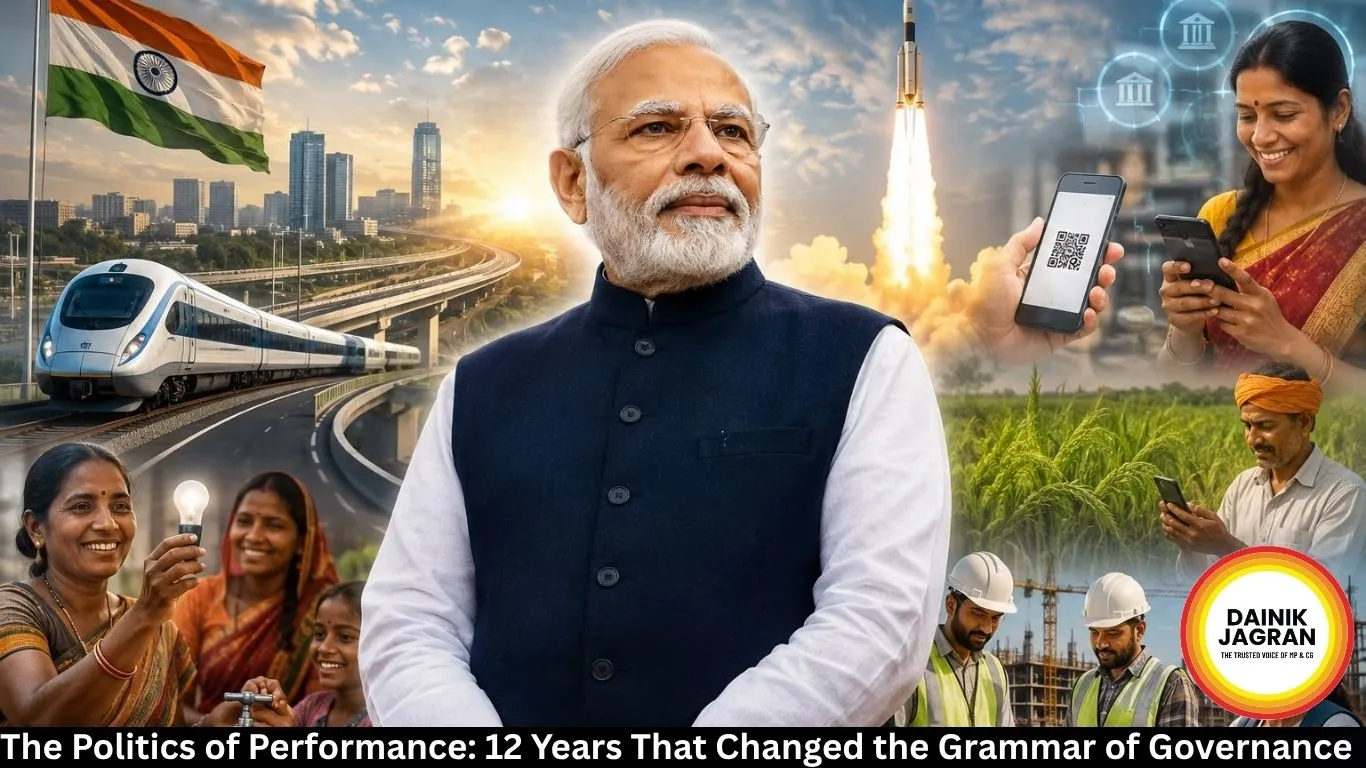
This transformation was reinforced by infrastructure development at unprecedented scale. Highways, expressways, Vande Bharat trains, logistics corridors and the PM Gati Shakti framework sought to reduce travel time, lower logistics costs and improve economic efficiency. The objective was not simply to build infrastructure but to build national capacity.
If there is a phrase that captures the governing philosophy of the last twelve years, it is perhaps the progression from reform to perform to transform and ultimately to scale. Structural reforms created the foundation, technology strengthened delivery, and scale ensured that outcomes reached hundreds of millions of citizens.
Decisions That Redefined the Political Landscape
Beyond governance reforms and economic transformation, the last twelve years under Prime Minister Modi's leadership were also marked by a governing conviction rarely seen in contemporary Indian politics: a willingness to pursue decisions that previous governments often regarded as politically untouchable, administratively difficult or electorally risky.
The abrogation of Article 370 ended a constitutional arrangement that successive governments had debated but ultimately left untouched for decades. The abolition of Triple Talaq addressed a question that had remained suspended between legal reform and political hesitation despite repeated public debate. More recently, the Waqf Amendment reflected a similar willingness to engage with institutional questions that earlier administrations often approached cautiously. Together, these decisions signalled a governing style defined less by caution and more by conviction.
That same confidence extended to questions of civilisational identity. The construction of the Shri Ram Mandir in Ayodhya and the transformation of the Kashi Vishwanath Corridor were not merely infrastructure projects or religious landmarks. They represented the fulfilment of aspirations that had occupied India's public discourse for generations. Their completion reflected a government willing to engage with questions of heritage, faith and identity that earlier administrations often preferred to navigate cautiously.
A More Confident India
The same assertiveness was visible in matters of national security and foreign policy. From Balakot to Operation Sindoor, from sustained defence modernisation to the commissioning of INS Vikrant, India's security posture increasingly reflected a doctrine of proactive response, strategic confidence and growing self-reliance.
Internationally, India's standing underwent a parallel transformation. Vaccine Maitri demonstrated India's ability to support the world during a global crisis. The successful G20 Presidency highlighted its growing diplomatic influence. Rising exports, stronger strategic partnerships and deeper global engagement strengthened India's international profile, while its emergence as a trusted "Vishwa Bandhu" expanded its role in global affairs. India increasingly moved from being discussed primarily as an emerging market to being recognised as an emerging power.
Twelve years later, individual schemes, reforms and decisions will continue to be debated. Yet the larger legacy of this period may lie elsewhere. It lies in reshaping the relationship between citizens and the state, in making governance measurable in everyday life, and in placing delivery, accountability and execution at the centre of political legitimacy.
Elections may still be fought on promises, but they are increasingly won on delivery. The achievement of the PM Modi-led NDA Government is that national progress is now measurable in the daily lives of citizens, while India's journey from an emerging market to an emerging power reflects the broader transformation of a nation that has sought to reform, perform, transform and scale.
--------
🚨 Beat the News Rush – Join Now!
Get breaking alerts, hot exclusives, and game-changing stories instantly on your phone. No delays, no fluff – just the edge you need. ⚡
Tap to join:
🟢 WhatsApp Channel: Dainik Jagran MP CG
Crave more?
🅕 Facebook: Dainik Jagran MP CG English
🅧 Twitter (X): Dainik Jagran MP CG
🅘 Instagram: Dainik Jagran MP CG
Share the fire – keep your crew ahead! 🗞️🔥
The Politics of Performance: 12 Years That Changed the Grammar of Governance
New Delhi
The story of the Modi-led NDA Government's twelve years is, in many ways, the story of India's transition from policy paralysis to decisive governance, from administrative leakages to direct delivery, from entitlement to empowerment, and from incrementalism to execution at scale. More importantly, it is the story of a political shift where performance, accountability and delivery increasingly became central to electoral legitimacy. The Modi years altered not only the functioning of government but also the expectations citizens place upon it.
Viewed broadly, this journey unfolded in three phases: system cleansing between 2014 and 2019, resilient crisis management between 2019 and 2022, and accelerated nation-building thereafter. Yet the thread connecting all three phases has been a consistent emphasis on measurable outcomes, responsive governance and a willingness to pursue decisions that previous governments often deferred.
From Policy Paralysis to Performance Politics
When the Modi-led NDA assumed office in 2014, one of its most immediate challenges was reviving an economy weighed down by stalled investments and administrative inertia. The unlocking of more than ₹10 lakh crore worth of stalled projects became an early signal that execution, rather than announcement, would define the government's approach.
Equally significant was the effort to repair the architecture of welfare delivery itself. The opening of more than 56 crore Jan Dhan accounts brought millions of previously excluded citizens into the formal financial system. Combined with Aadhaar-linked Direct Benefit Transfers, this created an unprecedented delivery mechanism through which benefits could reach citizens directly, reducing intermediaries and saving more than ₹2.5 lakh crore in leakages. Governance increasingly moved from promise-making to delivery-tracking.
The introduction of the Goods and Services Tax represented another structural shift. By creating a unified national market, simplifying the movement of goods and encouraging formalisation, GST altered the economic geography of the country. Monthly collections now exceeding ₹1.7 lakh crore reflect not only stronger revenues but also the growing formalisation of the economy.
This emphasis on fixing systems before expanding them became a defining feature of the Modi years. Whether through efforts to improve transparency, strengthen accountability, curb leakages or undertake difficult measures such as demonetisation, the larger objective remained consistent: to build a governance framework capable of delivering at scale. The last twelve years, therefore, are not merely years of schemes being launched; they are years of systems being repaired.
That philosophy extended directly into welfare. Swachh Bharat Abhiyan led to the construction of more than 11 crore toilets, improving sanitation, public health and dignity, particularly for women. PM Awas Yojana, household electrification and the Jal Jeevan Mission similarly sought to convert welfare from periodic assistance into long-term improvements in quality of life, asset ownership and basic living standards.
One of the most consistent themes running through the Modi years has been the emphasis on women's empowerment. Whether through sanitation access under Swachh Bharat, improved access to water and electricity, the abolition of Triple Talaq, or the passage of the Nari Shakti Vandan Adhiniyam providing 33 per cent reservation for women in the Lok Sabha and State Assemblies, the objective extended beyond welfare delivery. It reflected an effort to place women's dignity, security, participation and representation at the centre of public policy.
The resilience of this delivery architecture became most visible during the COVID-19 pandemic. At a moment of unprecedented disruption, the government leveraged its welfare and digital infrastructure to provide free ration to more than 80 crore citizens while using DBT systems to support vulnerable families. What had been built during years of system reform became a critical instrument of crisis management.
Building Capacity for a New India
If the first phase focused on repairing systems, the second sought to build capabilities for a rapidly changing economy.
The ₹20 lakh crore Atmanirbhar Bharat package transformed a moment of crisis into an opportunity for structural reform. Alongside Production Linked Incentive schemes, it supported businesses, protected jobs and strengthened India's manufacturing ecosystem across sectors ranging from electronics and pharmaceuticals to advanced technologies.
Few examples illustrate this transformation more clearly than mobile manufacturing. Once heavily dependent on imports, India today has mobile exports exceeding ₹1.9 lakh crore, reflecting a broader shift from import dependence towards production strength and global competitiveness.
At the same time, Digital India and UPI fundamentally transformed how Indians interact with the economy. What began as a digital payments platform evolved into one of the world's most significant public digital infrastructures, enabling street vendors, small traders, farmers and ordinary citizens to participate in the formal economy. Technology became not merely a tool of convenience but a mechanism of inclusion.
The government's focus increasingly expanded towards future sectors. The Semiconductor Mission, the growth of the startup ecosystem, investments in artificial intelligence, electric mobility, green energy and defence manufacturing reflected a recognition that future economic leadership would depend as much on innovation and technology as on traditional industrial strength.
This transformation was reinforced by infrastructure development at unprecedented scale. Highways, expressways, Vande Bharat trains, logistics corridors and the PM Gati Shakti framework sought to reduce travel time, lower logistics costs and improve economic efficiency. The objective was not simply to build infrastructure but to build national capacity.
If there is a phrase that captures the governing philosophy of the last twelve years, it is perhaps the progression from reform to perform to transform and ultimately to scale. Structural reforms created the foundation, technology strengthened delivery, and scale ensured that outcomes reached hundreds of millions of citizens.
Decisions That Redefined the Political Landscape
Beyond governance reforms and economic transformation, the last twelve years under Prime Minister Modi's leadership were also marked by a governing conviction rarely seen in contemporary Indian politics: a willingness to pursue decisions that previous governments often regarded as politically untouchable, administratively difficult or electorally risky.
The abrogation of Article 370 ended a constitutional arrangement that successive governments had debated but ultimately left untouched for decades. The abolition of Triple Talaq addressed a question that had remained suspended between legal reform and political hesitation despite repeated public debate. More recently, the Waqf Amendment reflected a similar willingness to engage with institutional questions that earlier administrations often approached cautiously. Together, these decisions signalled a governing style defined less by caution and more by conviction.
That same confidence extended to questions of civilisational identity. The construction of the Shri Ram Mandir in Ayodhya and the transformation of the Kashi Vishwanath Corridor were not merely infrastructure projects or religious landmarks. They represented the fulfilment of aspirations that had occupied India's public discourse for generations. Their completion reflected a government willing to engage with questions of heritage, faith and identity that earlier administrations often preferred to navigate cautiously.
A More Confident India
The same assertiveness was visible in matters of national security and foreign policy. From Balakot to Operation Sindoor, from sustained defence modernisation to the commissioning of INS Vikrant, India's security posture increasingly reflected a doctrine of proactive response, strategic confidence and growing self-reliance.
Internationally, India's standing underwent a parallel transformation. Vaccine Maitri demonstrated India's ability to support the world during a global crisis. The successful G20 Presidency highlighted its growing diplomatic influence. Rising exports, stronger strategic partnerships and deeper global engagement strengthened India's international profile, while its emergence as a trusted "Vishwa Bandhu" expanded its role in global affairs. India increasingly moved from being discussed primarily as an emerging market to being recognised as an emerging power.
Twelve years later, individual schemes, reforms and decisions will continue to be debated. Yet the larger legacy of this period may lie elsewhere. It lies in reshaping the relationship between citizens and the state, in making governance measurable in everyday life, and in placing delivery, accountability and execution at the centre of political legitimacy.
Elections may still be fought on promises, but they are increasingly won on delivery. The achievement of the PM Modi-led NDA Government is that national progress is now measurable in the daily lives of citizens, while India's journey from an emerging market to an emerging power reflects the broader transformation of a nation that has sought to reform, perform, transform and scale.