


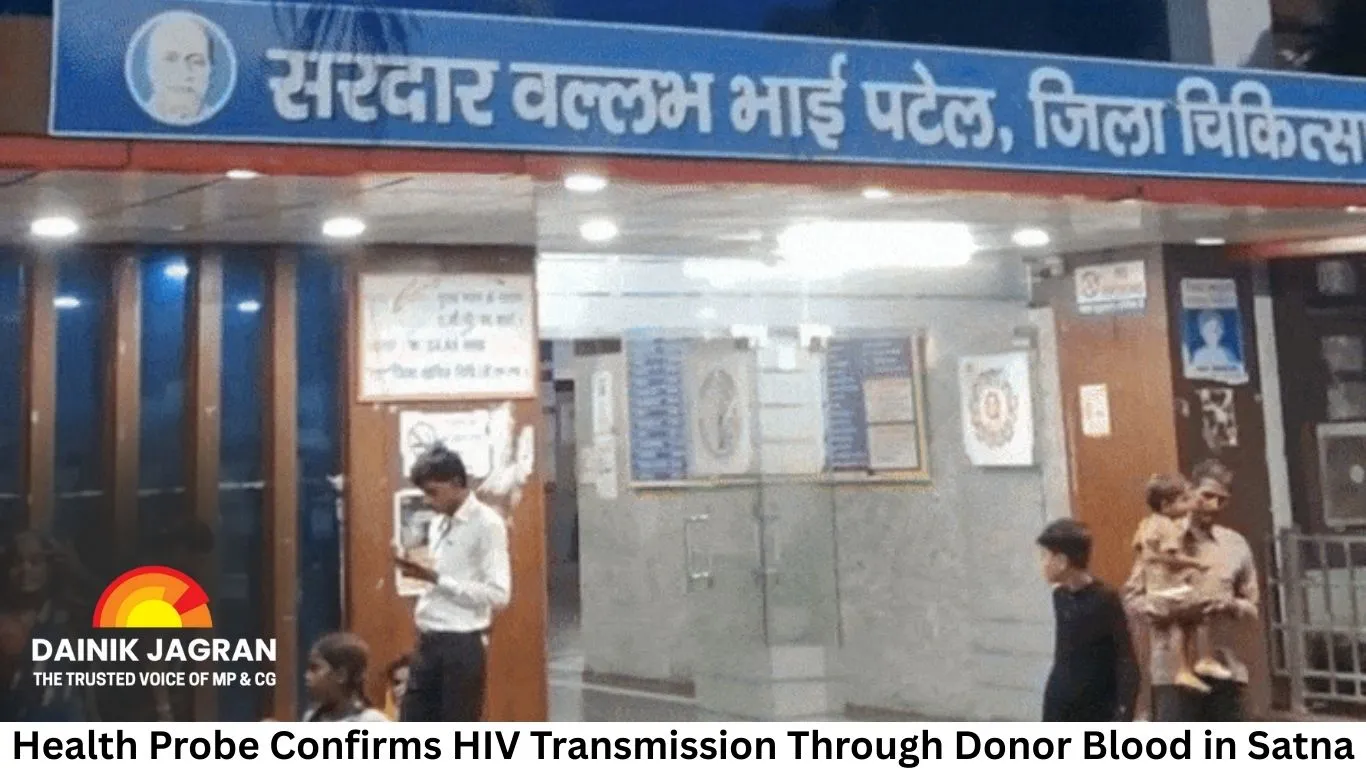
Health Probe Confirms HIV Transmission Through Donor Blood in Satna; Five Children Affected, Officials Under Scrutiny
Digital Desk
The three-member inquiry committee, constituted by In-charge Chief Medical and Health Officer (CMHO) Dr Manoj Shukla, concluded that the infection was transmitted through blood received from one or more donors. The panel has recommended that all donors linked to the transfusions be traced and individually verified.
The committee included pediatrician Dr Sandeep Dwivedi, pathologist Dr Devendra Patel and assistant manager Dr Dhirendra Verma. The team examined transfusion records, testing protocols and the blood component preparation process at the district hospital. Notably, Dr Patel also serves as the in-charge of the hospital blood bank, a factor that has drawn attention within the inquiry.
Parallel probes have been initiated. A central government team reached Satna on Wednesday to independently examine the case, while a state-level team is expected to arrive on Thursday.
The CMHO has also issued a notice to ICTC counsellor Neeraj Singh Tiwari, seeking an explanation within three days. Officials said that although five children tested HIV positive around nine months ago, the information was not formally reported to the CMHO. Hospital sources indicated that the initial testing was conducted at the ICTC located in the district diagnostic centre, while the notice was issued to the counsellor posted at Jagdish Bhawan.
The investigation has focused closely on the blood bank’s component separation process. The district hospital has been separating whole blood into packed cells, plasma and platelets since 2009. Thalassemia patients receive packed red cells, which, in this case, were prepared from blood donated by around 200 individuals.
Sources said remaining plasma is sold to a state-contracted agency that conducts advanced three-tier testing. The inquiry is now examining whether any lapse occurred during platelet use at the local level and whether this could have contributed to the infections.
Health authorities said further action would follow after donor tracing and completion of higher-level investigations.




.jpg)




