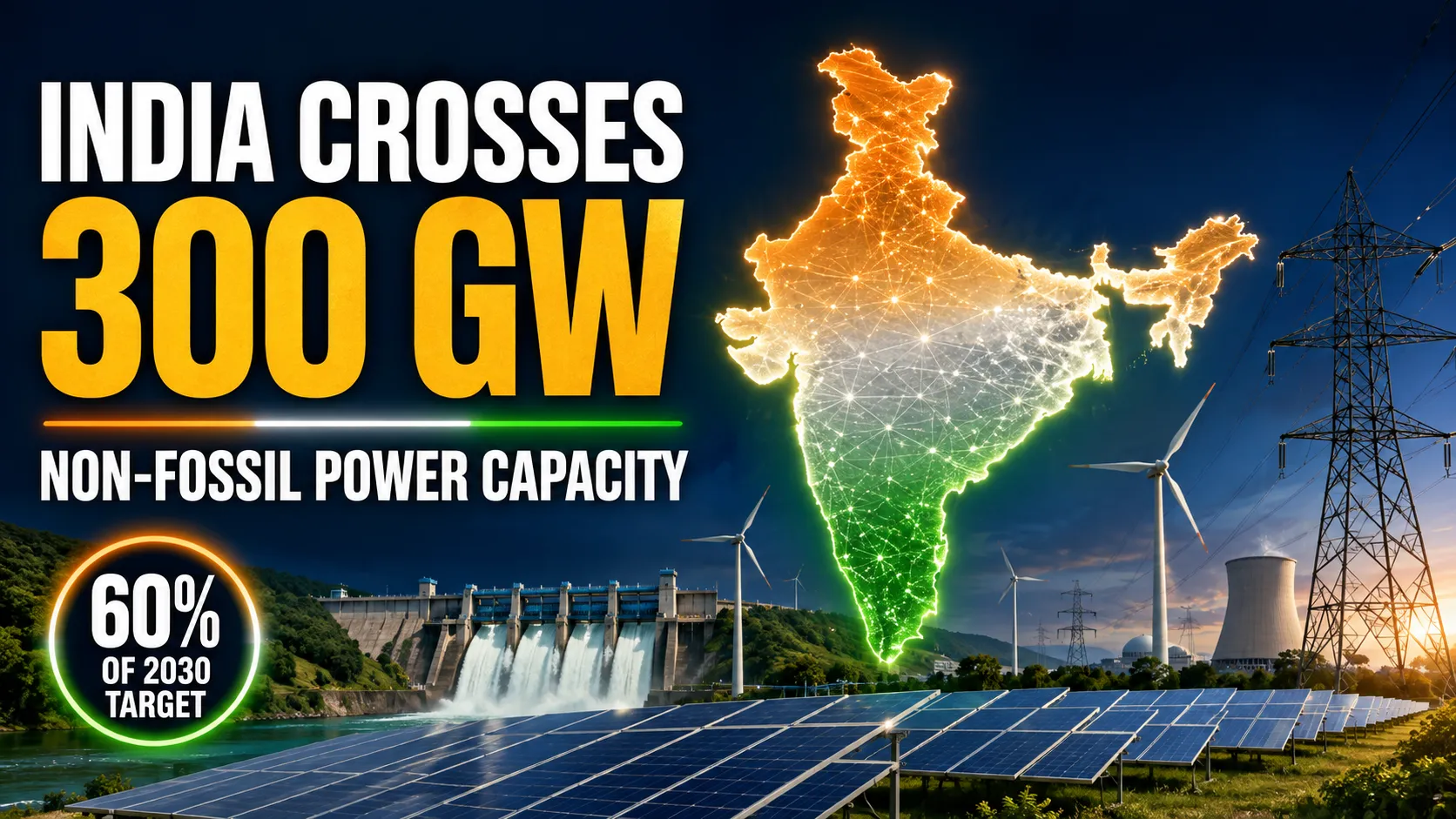
India Crosses 300 GW Non-Fossil Power Capacity, Reaches 60% of 2030 Target
Digital desk
Record solar and wind additions have accelerated India’s energy transition, but expanding storage and transmission will be critical to achieving the 500 GW target
India has crossed 300 gigawatts (GW) of installed electricity capacity from non-fossil-fuel sources, marking a significant milestone in the country’s clean-energy transition.
Union Minister for New and Renewable Energy Pralhad Joshi announced the achievement, saying India’s renewable-energy capacity had expanded approximately fourfold over the past 12 years. The milestone means India has completed 60 per cent of its target of establishing 500 GW of non-fossil power capacity by 2030. Akashvani News reported the announcement.
What Is Included in Non-Fossil Power?
Non-fossil capacity is broader than renewable energy alone. It includes solar, wind, hydropower and bioenergy, as well as nuclear power.
The government has not yet released the complete source-wise breakdown of the newly announced 300 GW total. However, official data show that India had 283.46 GW of non-fossil capacity on March 31, 2026.
| Energy source | Installed capacity on March 31, 2026 |
|---|---|
| Solar power | 150.26 GW |
| Wind power | 56.09 GW |
| Large hydropower | 51.41 GW |
| Bioenergy | 11.75 GW |
| Small hydropower | 5.17 GW |
| Nuclear power | 8.78 GW |
| Total non-fossil capacity | 283.46 GW |
Solar accounted for more than half of the capacity recorded in March, reflecting its growing importance in India’s power system. The country installed 44.61 GW of solar capacity during 2025–26, including rooftop and agricultural solar projects.
Wind-power additions reached 6.05 GW during the year, the highest recorded in a single financial year. Overall, India added a record 55.29 GW of non-fossil capacity in 2025–26, according to the Ministry of New and Renewable Energy.
Capacity Is Not the Same as Electricity Generated
The 300 GW milestone represents the maximum installed generating capacity of non-fossil power plants. It does not mean that these facilities continuously produce 300 GW of electricity.
Solar plants generate power only when sunlight is available, while wind generation varies according to weather conditions. Hydropower output can also fluctuate with water availability.
Although non-fossil sources now account for more than half of India’s installed electricity capacity, they supplied 538.97 billion units during 2025–26—about 29.2 per cent of the country’s total electricity generation.
Coal and other thermal plants consequently continue to provide a large proportion of India’s actual power supply, particularly during evening peak demand and periods of weak solar or wind generation.
India Needs Another 200 GW by 2030
India must install approximately 200 GW of additional non-fossil capacity to achieve its 500 GW goal.
That translates to an average addition of roughly 44–45 GW annually until the end of 2030. India’s record 55.29 GW addition during 2025–26 indicates that the required pace is achievable, but it will need to be maintained for several consecutive years.
The next phase will involve more than constructing solar parks and wind farms. India must simultaneously accelerate:
- Transmission-line construction between renewable-energy regions and major consumption centres.
- Battery and pumped-storage projects that can deliver electricity after sunset.
- Land acquisition and regulatory clearances.
- Long-term power-purchase agreements with distribution companies.
- Domestic production of solar modules, batteries, turbines and other critical equipment.
Transmission and Storage Become Critical
Large renewable projects are often located far from industrial centres and densely populated cities. Electricity generated in solar-rich Rajasthan or Gujarat, for example, must be transported across states without overloading the grid.
The government plans to expand India’s transmission network from approximately 5.04 lakh circuit kilometres in February 2026 to 6.48 lakh circuit kilometres by 2032. Inter-regional electricity-transfer capacity is expected to increase from about 120 GW to 143 GW by 2027 and 168 GW by 2032, according to the Ministry of Power.
Official planning also envisages approximately 47 GW of battery energy-storage capacity by 2031–32. Storage will allow surplus solar electricity generated during the afternoon to be supplied during evening demand peaks.
Why the Milestone Matters
India crossed the benchmark of 50 per cent cumulative installed electricity capacity from non-fossil sources in June 2025—five years ahead of the timeline set under its climate commitments.
Crossing 300 GW builds on that achievement and demonstrates the scale at which clean-power projects are now being commissioned. It could also reduce dependence on imported fossil fuels, support manufacturing investment and limit the growth of power-sector emissions.
However, the ultimate success of the transition will not be determined by installed capacity alone. India must convert that capacity into dependable electricity by expanding transmission, storage and flexible power systems.
The 300 GW landmark is therefore an important achievement, but the more demanding phase of India’s energy transition has only begun.

India Crosses 300 GW Non-Fossil Power Capacity, Reaches 60% of 2030 Target
Digital desk
India has crossed 300 gigawatts (GW) of installed electricity capacity from non-fossil-fuel sources, marking a significant milestone in the country’s clean-energy transition.
Union Minister for New and Renewable Energy Pralhad Joshi announced the achievement, saying India’s renewable-energy capacity had expanded approximately fourfold over the past 12 years. The milestone means India has completed 60 per cent of its target of establishing 500 GW of non-fossil power capacity by 2030. Akashvani News reported the announcement.
What Is Included in Non-Fossil Power?
Non-fossil capacity is broader than renewable energy alone. It includes solar, wind, hydropower and bioenergy, as well as nuclear power.
The government has not yet released the complete source-wise breakdown of the newly announced 300 GW total. However, official data show that India had 283.46 GW of non-fossil capacity on March 31, 2026.
| Energy source | Installed capacity on March 31, 2026 |
|---|---|
| Solar power | 150.26 GW |
| Wind power | 56.09 GW |
| Large hydropower | 51.41 GW |
| Bioenergy | 11.75 GW |
| Small hydropower | 5.17 GW |
| Nuclear power | 8.78 GW |
| Total non-fossil capacity | 283.46 GW |
Solar accounted for more than half of the capacity recorded in March, reflecting its growing importance in India’s power system. The country installed 44.61 GW of solar capacity during 2025–26, including rooftop and agricultural solar projects.
Wind-power additions reached 6.05 GW during the year, the highest recorded in a single financial year. Overall, India added a record 55.29 GW of non-fossil capacity in 2025–26, according to the Ministry of New and Renewable Energy.
Capacity Is Not the Same as Electricity Generated
The 300 GW milestone represents the maximum installed generating capacity of non-fossil power plants. It does not mean that these facilities continuously produce 300 GW of electricity.
Solar plants generate power only when sunlight is available, while wind generation varies according to weather conditions. Hydropower output can also fluctuate with water availability.
Although non-fossil sources now account for more than half of India’s installed electricity capacity, they supplied 538.97 billion units during 2025–26—about 29.2 per cent of the country’s total electricity generation.
Coal and other thermal plants consequently continue to provide a large proportion of India’s actual power supply, particularly during evening peak demand and periods of weak solar or wind generation.
India Needs Another 200 GW by 2030
India must install approximately 200 GW of additional non-fossil capacity to achieve its 500 GW goal.
That translates to an average addition of roughly 44–45 GW annually until the end of 2030. India’s record 55.29 GW addition during 2025–26 indicates that the required pace is achievable, but it will need to be maintained for several consecutive years.
The next phase will involve more than constructing solar parks and wind farms. India must simultaneously accelerate:
- Transmission-line construction between renewable-energy regions and major consumption centres.
- Battery and pumped-storage projects that can deliver electricity after sunset.
- Land acquisition and regulatory clearances.
- Long-term power-purchase agreements with distribution companies.
- Domestic production of solar modules, batteries, turbines and other critical equipment.
Transmission and Storage Become Critical
Large renewable projects are often located far from industrial centres and densely populated cities. Electricity generated in solar-rich Rajasthan or Gujarat, for example, must be transported across states without overloading the grid.
The government plans to expand India’s transmission network from approximately 5.04 lakh circuit kilometres in February 2026 to 6.48 lakh circuit kilometres by 2032. Inter-regional electricity-transfer capacity is expected to increase from about 120 GW to 143 GW by 2027 and 168 GW by 2032, according to the Ministry of Power.
Official planning also envisages approximately 47 GW of battery energy-storage capacity by 2031–32. Storage will allow surplus solar electricity generated during the afternoon to be supplied during evening demand peaks.
Why the Milestone Matters
India crossed the benchmark of 50 per cent cumulative installed electricity capacity from non-fossil sources in June 2025—five years ahead of the timeline set under its climate commitments.
Crossing 300 GW builds on that achievement and demonstrates the scale at which clean-power projects are now being commissioned. It could also reduce dependence on imported fossil fuels, support manufacturing investment and limit the growth of power-sector emissions.
However, the ultimate success of the transition will not be determined by installed capacity alone. India must convert that capacity into dependable electricity by expanding transmission, storage and flexible power systems.
The 300 GW landmark is therefore an important achievement, but the more demanding phase of India’s energy transition has only begun.
Recommended For You
--------
🚨 Beat the News Rush – Join Now!
Get breaking alerts, hot exclusives, and game-changing stories instantly on your phone. No delays, no fluff – just the edge you need. ⚡
Tap to join:
🟢 WhatsApp Channel: Dainik Jagran MP CG
Crave more?
🅕 Facebook: Dainik Jagran MP CG English
🅧 Twitter (X): Dainik Jagran MP CG
🅘 Instagram: Dainik Jagran MP CG
Share the fire – keep your crew ahead! 🗞️🔥