


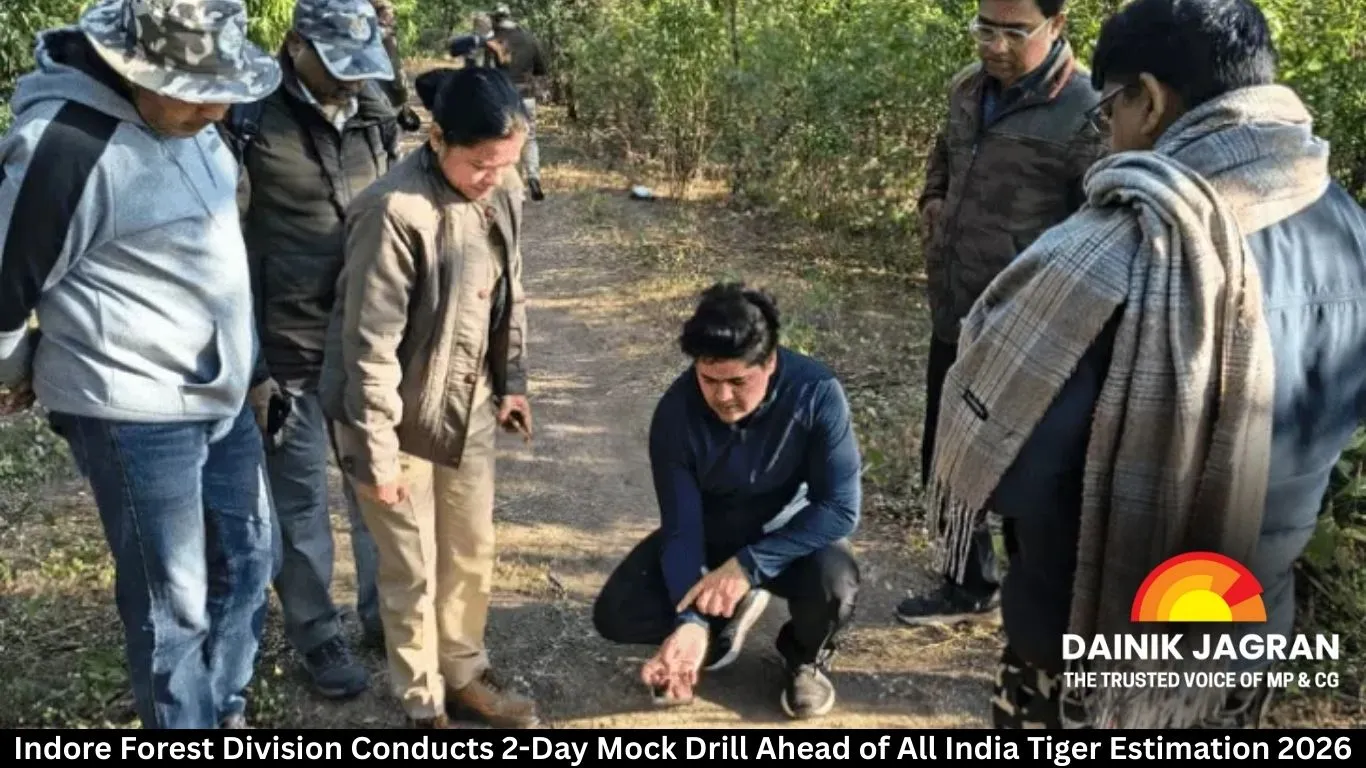
Indore Forest Division Conducts 2-Day Mock Drill Ahead of All India Tiger Estimation 2026
Digital Desk
The Indore Forest Division has successfully completed a two-day mock drill to strengthen field readiness for the All India Tiger Estimation (AITE) 2026, India’s largest and most comprehensive wildlife survey.
Conducted on December 11 and 12 across the Indore, Choral, Mhow and Manpur forest ranges, as well as the Ralamandal Sanctuary, the exercise aimed to refine survey methods and improve coordination ahead of the national census scheduled from December 18 to 24 in the division.
Forest officials said the drill was designed to ensure accuracy in data collection, standardise field practices and familiarise staff with the latest survey protocols before the actual estimation begins.
Day One Focused on Carnivore Survey
On December 11, forest teams carried out a carnivore-focused survey between 6 am and 10 am. While no confirmed tiger signs were recorded during the exercise, teams documented extensive leopard activity across multiple beats.
Field staff recorded fresh leopard pugmarks using geo-tagged mobile applications, along with tree scratches, scrapes and scent-marking sites. Multiple scat samples were also found, indicating recent leopard movement in the area. Signs of jackals and other small carnivores were noted as well.
Officials said the first day helped rangers sharpen their skills in identifying species-specific signs, navigating forest terrain and accurately logging observations, which are critical for the success of the national exercise.
Herbivore and Habitat Assessment on Day Two
The second day of the drill, held on December 12, focused on herbivore abundance and habitat assessment across 102 beats. Prey availability is a key ecological indicator, as carnivore presence and density depend heavily on herbivore populations.
Following AITE’s prey-based protocols, teams walked fixed transects and recorded grazing signs of sambar and chital, fresh hoof impressions of ungulates and dung samples of species such as chital, nilgai, blackbuck, barking deer and hare. Habitat indicators like browsing pressure and ground vegetation conditions were also assessed.
These observations help estimate ungulate density, an essential component in modelling tiger and leopard populations under the AITE framework.
Camera Trapping and Use of Technology
The Indore Forest Division covers nearly 700 square kilometres, with 200 square kilometres selected for camera trapping. The area has been divided into scientific grids of 2 square kilometres each, and camera installation is currently underway. Technical support is being provided by the Wildlife Conservation Trust under wildlife biologist Vivek Tumsare.
To strengthen monitoring, especially near human settlements, the Forest Department has also deployed a thermal-imaging drone capable of tracking nocturnal animal movement within a five-kilometre radius. Divisional Forest Officer Pradeep Mishra said the technology will help rapid response teams act quickly if leopards are spotted near populated areas.
Ready for the National Survey
Conducted every four years by the National Tiger Conservation Authority and the Wildlife Institute of India, AITE follows a four-phase scientific process, including ground surveys, satellite-based habitat mapping, camera trapping and national-level statistical analysis. The final nationwide report is expected by July 2026.
Forest officials said the mock drill has boosted confidence among staff and ensured uniform methods across teams. “The rehearsal has sharpened detection skills and habitat assessment methods. It will directly improve the quality of Indore’s contribution to the All India Tiger Estimation,” Mishra said.



.jpg)




